Photo Daniel Nartschick
anatomical research& Movement practice
THE JOURNEY
Research Process and Practice Development
My anatomical research developed over many years through a wide range of movement practices, teaching methods and performance traditions. It began with classical ballet and contemporary dance, and gradually expanded through yoga, Pilates, Qigong, martial arts and somatic practices. Over time, my interest shifted from learning techniques toward understanding the systems beneath them: how the body organises itself, how movement patterns are formed, how tension accumulates, how injury changes perception and how the body adapts through repetition and recovery.
Teaching became a major part of this process. Working with different bodies made it increasingly clear that no method can be universally applied. Each body carries its own history, habits, vulnerabilities and strategies of survival. This led me toward a more individual and investigative approach to movement, informed by anatomy but also by sensation, perception and psychological experience.
My practice was strongly influenced by methods including Feldenkrais, the Alexander Technique and Skinner Releasing Technique. These approaches shifted my attention toward neuromuscular organisation, habitual tension, alignment, efficiency, weight and release. They also introduced a different understanding of movement as something discovered through attention.
The research deepened significantly during my own process of injury and rehabilitation. Recovery became both a physical necessity and a research methodology. I began looking closely at muscular, ligamentous, tendinous, fascial and joint function, and at the relationship between injury, fear, compensation and movement memory. The process of healing became an investigation into how the body reorganises itself after disruption.
Alongside this, I explored Chinese Medicine, meridian theory, acupressure and Qigong, particularly Shaolin Qigong and embryonic breathing practices. These approaches expanded the research beyond musculoskeletal anatomy toward breath, circulation, energy and internal organisation.
Yoga and Pilates remained central tools, but increasingly as adaptable frameworks. I became particularly interested in how breath, pelvic organisation, spinal articulation, proprioception and hormonal changes influence movement quality. The Franklin Method further developed this interest through its focus on imagery, pelvic organisation and the relationship between internal perception and efficient movement.
The Alexander Technique brought renewed attention to the relationship between head, neck and spine and to the way postural organisation affects both movement and voice. This connected naturally to my experience with the Linklater voice method and opened a further line of inquiry into how breath, resonance and physical alignment influence expression.
Through Feldenkrais and Skinner Releasing Technique, the research returned again and again to softness, responsiveness and the reduction of unnecessary muscular effort. Improvisation became an important tool for allowing these principles to move beyond training into creative practice.
Over time, these different methodologies began to reveal shared principles. The research became a process of selection, adaptation and simplification.
funded projects
Funded by Dis-Tanzen Solo
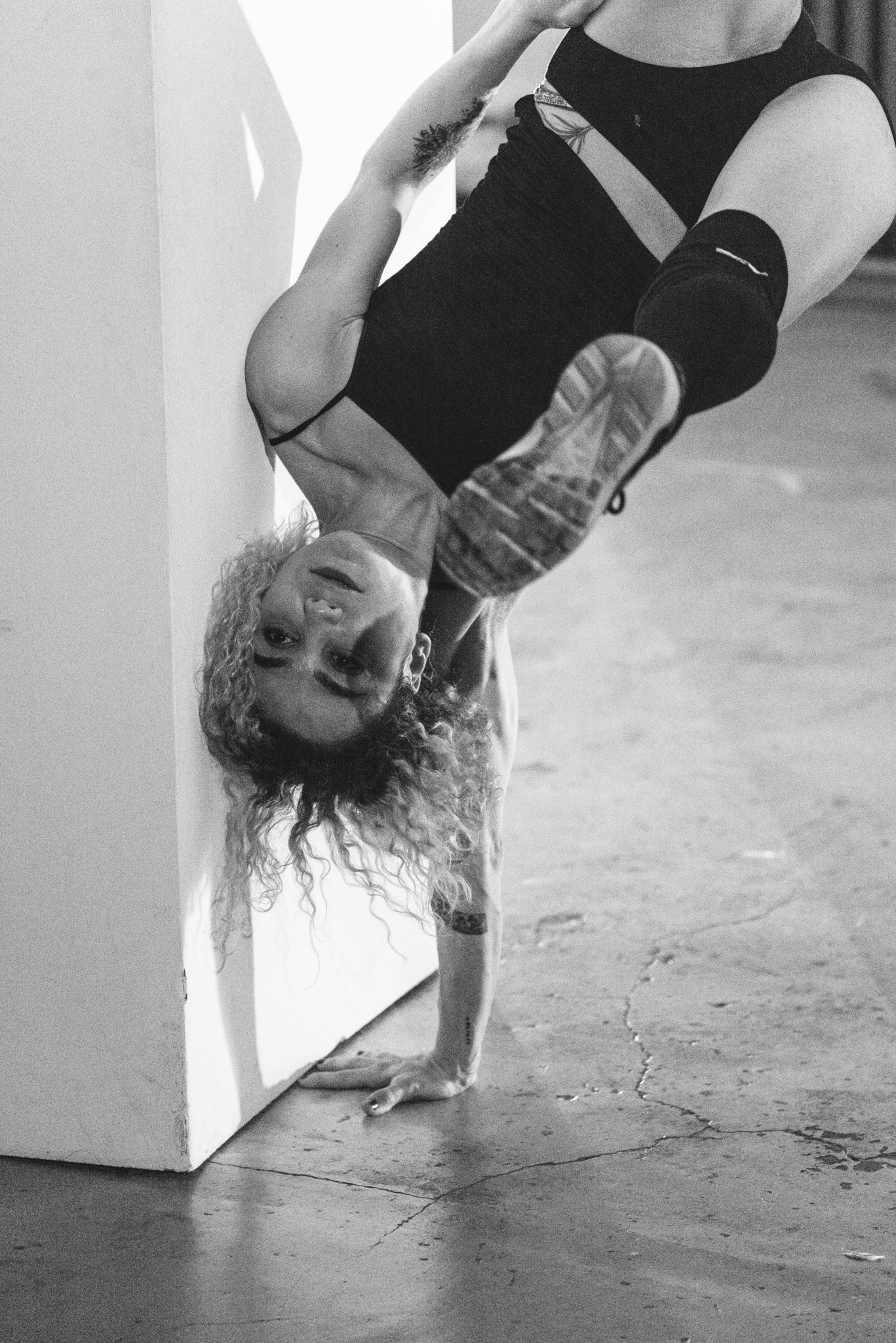
PHOEnix, Developing a FunCTIONAL MOVEMENT WORKOUT FOR PERFORMERS OVER 40
Phoenix emerged from this ongoing investigation as a concentrated research project around injury, regeneration, ageing and physical transformation.
The project resulted in a one-hour regenerative movement practice combining breathwork, self-massage, Qigong, yoga, Pilates-based exercises and free-flow improvisation informed by Feldenkrais and Skinner Releasing Technique.
The aim was not to create another fixed technique, but a flexible practice that could respond to changing physical needs. The research asks how performers can develop sustainable ways of moving through injury, ageing and physical change without losing curiosity, freedom or artistic vitality.
At the centre of the project is a simple idea: the body does not return unchanged. It adapts, reorganises and transforms.
As performers, we repeatedly fall, regenerate and return. In this sense, the dancer remains a phoenix through transformation.